Monday, March 15, 2021

Anyone for Chicken Yoga?

Ybor City—the old historic section of Tampa known for its hand-rolled cigars is also an official bird sanctuary where chickens have been prancing around the brick streets for decades on end. Since1989 no one is allowed to steal or harm them, and not surprisingly, the chickens have multiplied, and controversy has clouded the situation between those who want them removed and those who want them to stay.

Even bird lovers ask, what do we do with all these chickens?

Well how about chicken yoga?



Experts discovered that the combination of animal therapy and yoga has proven to be calming, and there’s already goat yoga, cat yoga, and dog yoga, so why not lay on the floor of the Hotel Haya and do yoga with a herd of chickens clucking about? 

And these are special birds.

Before checking into the hotel, these abandoned domesticated chickens, who live in the Ybor Misfits Microsantuary, are bathed and diapered. “We get the diapers from Etsy and they wrap over the wings and under the legs for a perfect fit,” said Dylan Breese, the director of the sanctuary, who tries to maintain the peace between the residents and businesses. “Once [the diapers are] snapped over the back, they’re ready for some crescent hinges and warrior poses.”

At least the people around them feel safe to stretch.
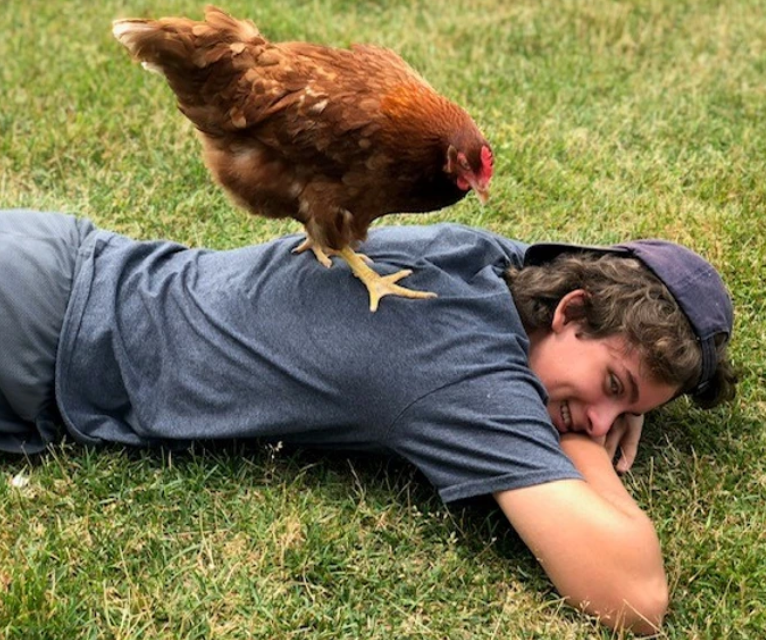


Classes are held on the final Sunday of each month, and the 55 spaces fill up quickly, so now’s your chance. Have you ever dreamed of lying amongst a bunch of flapping feathers while stretched out in the Downward Dog? Or balancing high in an Upward Plank?

But be careful, don’t fall, or you’ll collide into a mass of flying chicken fricassee shrieking against your frightened face. 

Still, it’s only yoga. So relax, and enjoy.

Saturday, September 26, 2020

Let's Give a Shout-out to Our Mail Carriers

Neither snow nor rain nor heat nor gloom of the night stops these carriers from the swift completion of their appointed rounds.

No, these words are not the motto of our postal service though for the last 100 years, that’s what people believed. They were actually written by Herodotus in 500 B.C. about the Persian Wars. Still it fits like a Michael Jordan high-end sneaker. Nothing has ever seemed more reliable than our mail but suddenly they can’t do anything right. They can’t be trusted, the agency is corrupt, inept, disorganized, and worst of all dishonest. It’s gotten so, that the ordinary American is frightened to send a stamped letter and deposit it into the mailbox.


But the postal service, born in 1775, has a top-notch rating though many have tried to trick the system. Hundreds have been caught, fined, and sent to prison. Still, there are some who’ve beaten it for their own egregious use while other incidents became laughable, even sobering.

In 1849, a Virginia slave dreamed of mailing himself to a place where there were no slaves at all. With $86 and the help of a storekeeper, he was boxed up with water and biscuits before sending himself up north. A Philadelphia abolitionist agreed to receive the package.

The journey began on March 23 and ended 27 hours later. The box was passed from wagon to railroad to steamboat, often turned upside down, but he must’ve kept quiet because nobody heard him, and on March 24, the box arrived in Philadelphia, and he was released as a free man.

In 1914, the parents of May Pierstorff wanted to send their five-year-old daughter from Grangeville, Idaho to her grandparents in Lewiston, Idaho. The railroad ticket cost too much, so they decided to mail her instead. Upon her arrival in Lewiston, the postmaster unboxed her and delivered the child to her grandparents’ house.

Six years later it became illegal to send humans by mail.

Still, how reliable is our postal system?

In 1958, Harry Winston decided to gift his $350 million Hope Diamond to the Smithsonian Natural History Museum in Washington, D.C.  He sent it by registered mail from New York, paying $2.44 for postage and $142.85 for a million dollars worth of insurance. Letter carrier, James G. Todd picked up the package at the City Post Office in Washington and drove to the museum. Entering the side door of the Gem Room, he placed the box into the hands of Leonard Carmichael, Secretary of the Smithsonian.

The deed was done.  

The next day Harry Winston told the Washington Evening Star, “It was the safest way to send it.”

So get your hands off our postal service, Trump, and let’s hear some cheering for our downtrodden but hardest working men and women of all.


Saturday, September 12, 2020

The Breck Girls


Ever hear of the Breck Girls? Am I getting too old or do you remember Breck Shampoo advertised in many women’s magazines, usually on the back cover of Glamour, Seventeen, Ladies Home Journal, Vogue, and Harper’s Bazaar?

It was created in 1930 by John Breck, who believed “every woman was different,” and placed ads displaying a unique face every month. The first chosen was family, friends, employees, and even strangers on the street. In 1936 Breck’s son, Edward took over the management and hired artist, Charles Gates Sheldon, who preferred to draw lovely women, instead of clicking still photos. His first portraits were done in pastels with a soft focus that included halos, light, and color surrounding them.

They were stunning in their beauty and in their romantic portrayals.

In 1957 Ralph William Williams succeeded Sheldon and chose professional women until 1972 when Kim Basinger, prior to her acting career, won her chance and walked in for the shoot with her gorgeous mother, Ann.

The artist and his assistants gaped at them both, and for the first time in the company’s history, a pair of faces graced the back covers, and women were thrilled with the change.

The ads became bolder, and other groups followed, including single portraits of Cybill Shepherd, Farrah Fawcett, Cheryl Tiegs, and Brooke Shields, among others.

But beauty and makeup changed over time. The artificial look of the thirties through fifties with pencil-thin eyebrows, darker lipsticks, and glistening rouge across the cheeks morphed to more natural looks while still remaining feminine.

I used to wait for next month’s Seventeen, and later, Ladies Home Journal, before flipping to the back cover and studying the newest face. Oh, this one was gorgeous, I thought, while figuring how I could make my hair look that.

I never came close.

In 1990 Breck sold out to the Dial Corporation that was bought by Henkel, who licensed it to Dollar Tree and produced it for institutional use. It was a long winding trail, and along the way the Breck Girls got lost in the numbers.

Sad, I thought, until I learned that the Smithsonian Museum of American History had collected them all. Like Fonzie’s jacket and Dorothy’s ruby slippers, we can still view the loveliest of twentieth century American women.

Saturday, August 22, 2020

Unhappy White House Wives


When I heard that Donald and Melania had a nasty fight on inauguration day, I chuckled, studying the video of them dancing the evening together. They sure didn’t look too happy. Neither smiled nor spoke, and they barely held each other close. Like two wooden dummies, they fulfilled their obligations and attempted to force their miserable faces into a happy expression.

After the inauguration, Melania flew to New York to finish packing but was late arriving back to Washington because she refused to show up until she renegotiated her prenup. Smart lady, I thought. Get it done before he throws you aside like he did all the others. 

I wondered how many other presidential couples had to fake it in the public eye. Turns out there were lots of them, but Warren and Florence Harding rise to the top, barely tolerating the other.  Harding won the presidency in 1921 but died two years later. His time in office was short, but hardly sweet. His friends were crooks, like Trump’s, and although he was never implicated, he showed lack of judgement and foresight.

In other words, he was just plain dumb while busily loving his mistress. He fathered a daughter, Elizabeth Blaesing, in 1919, the only child he ever had. Although Florence felt no love for him, she was devastated by the rumors of the child and soon learned the truth. One man wrote a book about the affair while others claimed it was nothing but a lie.

When his scandals began going public, Harding decided to tour the country and explain his policies when he died of a sudden heart attack in his San Francisco hotel room.

Florence claimed she had been reading to her husband at the time of his passing, but one journalist stated she had actually poisoned him. 

She didn’t, or probably didn’t, the scholars say, but we’ll never know for sure.

There were lots of unhappy marriages though Andrew Jackson had the opposite problem. He loved his wife Rachel so passionately that he was willing to die for her.

When Rachel was seventeen, she married an abusive man and continually suffered his beatings and black eyes. When Jackson came upon her, she was still married but covered with bruises. Sickened by the horror, Andrew rescued her, and they lived together unmarried until they tied the knot in 1791.

Trouble was, her divorce didn’t come through until 1793, which meant Rachel was married to two men for a couple of years. Word got out, and John Sevier, the Tennessee governor, cracked a joke about Rachel’s infidelity to Jackson. Enraged, Jackson drew his pistol. Shots rang out, but no one was killed.


Yet things turned uglier the next time around. After arguing about a horse race that turned into a fight about his wife, Jackson got shot but still managed to kill the man. 

The presidential election became downright dirty, and the stress grew so intolerable that Rachel died soon after, never living to occupy the White House. Heartsick and bitter, the seventh president entered the mansion alone.

Saturday, March 25, 2017

Traveling with the blind on Viking

Sitting in the theater one night watching a slide show of our next day's adventures, I turned around and saw three women sitting with their seeing eye dogs.

 Image result for Viking

ccccccccccccccccccccccc

Image result for three blind mice

bbbbbbbbbbbbbbbbb

Monday, March 17, 2014

FAINTING GOATS


fainting goat

Hey, how about those fainting goats?   Ever thought of them?  Yeah I haven't either.  I didn’t even know they existed until I saw a video and instantly fell in love.
 
What kind of cute little creatures keep falling down only to rise ten seconds later and take on the world and its problems again.  Are they for real?  I wondered.  With a sensible case of skepticism, concern, and natural curiosity, I started checking them out.

Smaller than the average goat—whatever that means— they plop on their backs and sides whenever they start feeling panicked.
No need for Zoloft or a quick dose of Valium.  Fainting goats do better than that.  They come with all kinds of facial features, but no matter if their ears press up or flop down, they all take a natural break whenever they feel the slightest twinge of pressure.

The slightest twinge.  
Wow.  What a convenient way to live.           
floppy ears

 Without losing consciousness, these guys drop to the ground and instantly remove themselves from the frantic pace of the modern world.  And no one knows why.  
Maybe they instinctively create their own tension, like clocking in and out of the job or worrying about picking up their kids on time.    
I know employers aren't crazy about them, disapproving of the continual work stoppage while watching their employees rise and fall like a bunch of pogo sticks high on crack cocaine. 
But I guess the White House isn't getting any calls,
up ears
so everyone's cool.   


Yet think a moment.   Isn’t this exactly what we all want to do—drop out from the world—from the bullies, from the irate customers,  from the hyperactive kids, if only for a minute, if only for a second or two.


You know, on second thought it's not a bad way to live.   Could even be a dream come true.
 

Monday, February 17, 2014

No, No Noro--the Virus, that is

The Allure of the Seas 
We just got off the Allure of the Seas.  Never heard of it?  It’s the largest passenger vessel floating the waters today, five feet longer than its twin the Oasis--huge like a monster, like Moby Dick on steroids.  Some of the decks were lined with 1600 staterooms.  I finally remembered to carry my water on our way to our cabin from the elevator.  They should consider serving snacks, i.e., after my four course dinner, chocolate cupcake, and visit to the candy store.  But I digress.


one of the theatres
In the months before leaving home, I had never glanced at a picture of  the boat.  Or of anything on it--not the sleeping quarters, swimming pool, basketball court, theatres, comedy club, ice rink, carousel, or the miniature Central Park they built along deck eight.   Who gets wound up with petty details if you're about to meet your demise?

Christ, I was paying for a trip in the land of noro-virus, a perfect setup to catch the ultra-contagious illness where your insides spew from every available portal.
So why was I going?   Because my husband was having a small family reunion—five couples attending, one cousin from each pairing, looking forward to reconnecting after many years apart.

Fun for them, I thought, but death was my only reward.  I was certain I wouldn't survive, so I studied the odds.  Out of 23 million traveling by ship each year, only 2,300 get sick.  Only?   Still, another Royal Caribbean had been hit two weeks earlier, and a few days later one of the Princess ships.  Who knew that a Princess carried germs?

I was stuck, so I planned my inevitable demise, praying that the captain would quote something inspirational before dumping me over the sides.    

Maybe the two of us should have a little talk, I thought, making my way up the gangway to join the masses ahead.  Probably a few thousand others on this ship when I quickly learned there were 6,000 passengers and 3,000 crew.

Nine thousand people carrying a zillions germs!  I was going, going...

My husband and I somehow ended up on Deck 5, the busy and decorative Royal Promenade.  Lined with shops and restaurants with special sales tables smashed in the middle, the place was more crowded than Macy’s the day before Christmas.  And suddenly there was tons to do, and I wasn’t going to miss a thing.  Bob's cousins joined us, and they ended up wonderful.  They were smart, funny, and told a good story.   And so did their spouses.

Besides, I found a half priced bag at the Guess tables and grabbed up some look-a-like Pandora bracelets.  Funny because I hate Pandora and I’m not too crazy about Guess...

But it’s part of the cruising life, you doubters out there, and I made it home kicking and yakking and complaining nonstop.  Well life doesn’t change, does it?

And I’m grateful for that too.

Monday, January 20, 2014

No Problem? Absolutely!


When Bill Flanagan from CBS News asked for a glass of water in a restaurant, the waitress answered, ‘no problem.’”   Flanagan fumed and wanted to say, “WHY do YOU think I think it would be a problem for you to get me a glass of water?   [And] why [does] everyone born after 1980 decide that 'no problem' [is] interchangeable with 'You're welcome?'"

I couldn’t agree more.  My fingers begin curling into fists when some young person says "not a problem."  Why can't they just say a simple "yes," or “sure."  Either would suffice.
 It seems this generation makes a mountain out of nothing when most of it's a routine answer, just part of their job. 

Of course if I happen to fall, and a kind person helps me to my feet, answering “no problem” is appropriate.  But a waitress reciting that phrase after I dropped a fork?   “Didn’t think it was a problem in the first place,” I mumbled, when asking for a clean utensil.
A week later I was pushing my basket through Publix and I turned into soft drinks when I saw that the two-liter bottle of Sprite I needed was on the top shelf.   Barely five, one, I’ve been known to climb sturdy shelves to reach my goals, but I didn’t want to chance it that day.  Besides, there was this great big guy just a few feet away in Pepsi.   "Could you help me?" I asked.  
“No problem."

Another problem?  Well not for him.  At least six-five, he could easily lift the bulky bottle the same as I do when reaching for a package of cream cheese from the fridge.    
I don't think that the phrase"no problem" will never go away though lately there might be a glimmer of hope.   Something different has been heard, and the young are busy rearranging their brains.  Yes, it's absolutely so. 
Absolutely what, you ask? 

I spoke to a twentyish guy behind the counter in the paint store last week.   “So you can mix these three colors together?" 
“Absolutely.”
“You mean not a problem,” I said.
“Absolutely not a problem.”
“And you can do it while I wait?”
“Absolutely.”
Can I have all your money? I wanted to ask while he was still on a roll but stopped myself in time.  Instead I said, “So this 'no problem' thing has been fading away?”

“What?”
“I mean you'll combine these paints in a minute?"
“Absolutely,” he repeated.

I could feel my fingers beginning to move.  Yes, they started to wrap around, grow tighter, and finally curl.  I can swear on it.  Absolutely.


Sunday, December 22, 2013

The Secret of My Mother's Name


A cross-eyed girl
My parents were Bernie and Evelyn Schwartz.  

 Sounds simple enough since my father never had a middle name, and my mother’s middle name was May.  But at birth my mother was Evelyn May Kosoglad.   Koso what? you ask.  Can you say that again?   

No one ever gets it right the first time, but as one cousin said.  “It’s just ‘O-so-glad with a K.’”  

Sort of friendly, I thought, until I learned the true meaning.  In Russia, where all my grandparents were born, the odd moniker meant cross-eyed.  So what did this say about my family?  Did my great great great grandfather make his way in this world staring at his toes?  Why else would  he pick a disgusting name like that?  I soon began researching the origin of this nightmare.           

Most Europeans acquired surnames around 1000 A.D., but Jews weren’t assigned until the early 1800s when Napoleon came to power and was busy conquering the world.  I guess they suddenly felt the need for full identification to serve in the czar’s army, or more likely to escape it.
     
Before then, people only used first names, and further clarification was only needed when there were two Peters or two Charles in town.  In those days they either used the father’s name, like Peter, son of John, who became Peter Johnson, or they selected the family’s profession, like Charles son of the Goldsmith, who naturally became Charles Goldsmith.

But each last name changed in every generation.

So if Peter had a son John, he became John Peterson, but only until John had a child of his own.  If John named his own son William, the boy then became William Johnson.  In effect, each family created a totally different last name every twenty years or so, which got more than a little confusing.

I suddenly have empathy for cross-eyed people.

How did they solve this problem?   Russia, always the innovator, produced a new plan.  Everyone could pick a surname, but the prettier it was, the more you paid for the privilege. 
And that was the problem. 
My ancestors were obviously short a couple kopeks so buying a decent name was out of the question.  Unable to bribe the government officials, the poorest of the peasants were assigned nasty names—like the Russian equivalents of dumb, lazy, stupid, and (I sigh), a little cross eyed.

That was my mother’s inheritance.
 
My mother's family luckily emigrated to America in the early nineteen hundreds.  Born in the twenties, Evelyn May Kosoglad was one of six children, five girls and a boy, which made my Uncle Sol the only one stuck with his surname for life.    Married with three children, he solved the problem once and for all.  Sol petitioned a Michigan court and changed Kosoglad to Keller,  finally ending the tyranny of the czar and any future cross-eyed descendants.

And the moral of this story is:  Don’t take our freedoms for granted.  My family now owns stock in Lenscrafters, and our eyes see straight ahead.